Heather McGill / "The Last Time I Saw Richard"
The Sculpture Center, Cleveland
9/24 - 12/18, 2010
by Lyz Bly
Like any diary, letter, or newspaper article, a work of art serves as an artifact
from a moment in history, and by interpreting it we gain insight into the period
and culture in which it was created. Heather McGill’s installation, “The Last
Time I Saw Richard,” which is currently on view at The Sculpture Center, is a
densely layered work full of indications that these are indeed troubled times.
On its surface, the work is a spectacle unto itself, with its brightly colored plaid,
intricately cut floor-to-ceiling chains of paper stars and flowers, black stenciled
patterns, slick pink and blue plaid airplane wings, and neatly framed
components. The immediate visual sensation contradicts the melancholic mood
of the Joni Mitchell song of love and loss after which the piece is titled.
However, on closer inspection, McGill’s work explores the violence and despair
of a culture grounded in violence, oppression, and consumerism. In one of
three framed elements, McGill evokes the larger installation with a series of
smaller strands of stars and flowers, which dangle in front of a spectacularly
colored composition of layered paper. The largely geometric abstract
composition includes a clearly discernable genie lamp, with text emerging from
it, which reads “You be the judge 45 or 410?” The text references an ad the
artist saw for the gun models (.45 versus .410) which depicted a single bullet
hole in the skull of one victim next to a depiction of a person’s head after a
significant portion of it was blown off by the more powerful of the two weapons.
The sad irony of the advertisement was clearly not lost on McGill, who lives and
works near Detroit, one of the most impoverished and embattled cities in the
country, particularly amid the current economic crisis.
Despite the impressive intricacy of the chains of paper stars and flowers (McGill
hand paints the plaid patterns, her assistant Aaron Peterman digitizes them,
and then the artist laser cuts and hand assembles the chains), the most visually
compelling parts of the installation are the black stenciled illustrations painted
on the gallery wall. Like everything in “The Last Time I Saw Richard,” there is
much more labor behind each component than meets the eye; from a distance
the stenciled floral motifs and female figures appeared to be cut vinyl (a
material that is commonly used in galleries for exhibition titles and didactics),
yet it was hand painted using a laser cut stencil. The result is stunning, as the
rich black pigment against the pure white walls further emphasizes the detailed
content of the work. Again, in what appear to be merely decorative patterns,
McGill articulates two feminine caricatures—the exotic dancer and the
cheerleader, who, in true, 2-D form represent the most common mass media
depictions of women as either whores or enthusiastic supporters of patriarchal
interests and desires in a society that is often labeled “post feminist.”
The pink-blue metallic plaid airplane wings that hover protectively above the
dancing and cheering two-dimensional women is, in fact, modeled after a the
wingspan of a balsa wood toy airplane, which, fittingly, is a miniature replica of a
World War II bomber that was manufactured in Detroit. In this context, the
wings evoke a time when the American economy was booming and Detroit was
a brighter, more hopeful place. Through the airplane wings we are reminded,
however, of the cost of the economic boom of the post-War era and birth of the
nuclear age and Cold War era. Moreover, the American affluence after World
War II was accompanied by a return to traditional gender roles; women needed
to be enthusiastic sex kittens in the bedroom and devoted mothers in the
kitchen, as there were lots of new products to buy and corporations needed
plenty of healthy, affluent future consumers to keep the profit margin strong.
McGill created an extremely complex installation that is also visually dazzling.
While it is in some ways inscrutable because of its layered complexity, it is
difficult the fault the artist, who is attempting to tease out the past and the
present to understand this challenging moment in American history.
The Sculpture Center, Cleveland
9/24 - 12/18, 2010
by Lyz Bly
Like any diary, letter, or newspaper article, a work of art serves as an artifact
from a moment in history, and by interpreting it we gain insight into the period
and culture in which it was created. Heather McGill’s installation, “The Last
Time I Saw Richard,” which is currently on view at The Sculpture Center, is a
densely layered work full of indications that these are indeed troubled times.
On its surface, the work is a spectacle unto itself, with its brightly colored plaid,
intricately cut floor-to-ceiling chains of paper stars and flowers, black stenciled
patterns, slick pink and blue plaid airplane wings, and neatly framed
components. The immediate visual sensation contradicts the melancholic mood
of the Joni Mitchell song of love and loss after which the piece is titled.
However, on closer inspection, McGill’s work explores the violence and despair
of a culture grounded in violence, oppression, and consumerism. In one of
three framed elements, McGill evokes the larger installation with a series of
smaller strands of stars and flowers, which dangle in front of a spectacularly
colored composition of layered paper. The largely geometric abstract
composition includes a clearly discernable genie lamp, with text emerging from
it, which reads “You be the judge 45 or 410?” The text references an ad the
artist saw for the gun models (.45 versus .410) which depicted a single bullet
hole in the skull of one victim next to a depiction of a person’s head after a
significant portion of it was blown off by the more powerful of the two weapons.
The sad irony of the advertisement was clearly not lost on McGill, who lives and
works near Detroit, one of the most impoverished and embattled cities in the
country, particularly amid the current economic crisis.
Despite the impressive intricacy of the chains of paper stars and flowers (McGill
hand paints the plaid patterns, her assistant Aaron Peterman digitizes them,
and then the artist laser cuts and hand assembles the chains), the most visually
compelling parts of the installation are the black stenciled illustrations painted
on the gallery wall. Like everything in “The Last Time I Saw Richard,” there is
much more labor behind each component than meets the eye; from a distance
the stenciled floral motifs and female figures appeared to be cut vinyl (a
material that is commonly used in galleries for exhibition titles and didactics),
yet it was hand painted using a laser cut stencil. The result is stunning, as the
rich black pigment against the pure white walls further emphasizes the detailed
content of the work. Again, in what appear to be merely decorative patterns,
McGill articulates two feminine caricatures—the exotic dancer and the
cheerleader, who, in true, 2-D form represent the most common mass media
depictions of women as either whores or enthusiastic supporters of patriarchal
interests and desires in a society that is often labeled “post feminist.”
The pink-blue metallic plaid airplane wings that hover protectively above the
dancing and cheering two-dimensional women is, in fact, modeled after a the
wingspan of a balsa wood toy airplane, which, fittingly, is a miniature replica of a
World War II bomber that was manufactured in Detroit. In this context, the
wings evoke a time when the American economy was booming and Detroit was
a brighter, more hopeful place. Through the airplane wings we are reminded,
however, of the cost of the economic boom of the post-War era and birth of the
nuclear age and Cold War era. Moreover, the American affluence after World
War II was accompanied by a return to traditional gender roles; women needed
to be enthusiastic sex kittens in the bedroom and devoted mothers in the
kitchen, as there were lots of new products to buy and corporations needed
plenty of healthy, affluent future consumers to keep the profit margin strong.
McGill created an extremely complex installation that is also visually dazzling.
While it is in some ways inscrutable because of its layered complexity, it is
difficult the fault the artist, who is attempting to tease out the past and the
present to understand this challenging moment in American history.
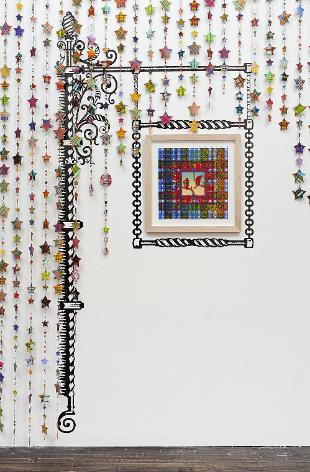
Heather McGill, "The Last Time I Saw
Richard, 2010
(dimensions variable)
Richard, 2010
(dimensions variable)