Double Visions
Ken Nevadomi at CSU Gallery
by Douglas Max Utter
For more than thirty years Cleveland based painter Ken Nevadomi’s very personal iconography
and style have emerged from a mix of painterly concerns and an interest in ideas – often
underwritten by a tough vision of urban life. Sometimes, as in the 1986 “The Man Who Lived in a
Refrigerator” (which was one of two works by Nevadomi awarded the coveted Painting Prize in the
Cleveland Museum of Art’s 1986 May Show), these appear to comment on social conditions. But
Nevadomi is an activist only in the sense that he’s involved in the world at street level, with a keen
eye for anecdote and for the absurd. His often dream-like works argue for the importance of
beauty, stranded and disfigured as it may be amid the intensely emotional hues and harsh textures
of daily existence.
The one person show “On the Corner Off” consists mostly of large acrylic paintings, completed
over the past twelve years or so, which manage to hold their own in Cleveland State University’s
soaring gallery space. All are executed on unstretched canvas and pinned to the wall, stressing the
rough-edged immediacy of Nevadomi’s several recent manners. In these works passages of art
historical reference alternate with semi-comic, off-the-cuff observations, stirred briskly with bravura
brushwork and energetic spattering. Some depict interior scenes, others are nearly abstract, like
several six by ten foot diptychs on display, composed of two side-by-side sections that repeat key
motifs. Each of these features a graffiti-like tangle of boldly drawn images: things having to do with
the philosopher Renee Descartes, a selection of images derived from paintings by Matisse, and a
snarl of WWII-era bombers.
Nevadomi renders firmly outlined, cartoon-like human figures when he’s using paint on canvas,
although over the years one of the hallmarks of his works on paper has been a much more realistic
linear sensitivity. In the paintings at CSU Nevadomi’s underlying gifts as a draftsman and observer
become a matter of psychological overload; he achieves a shaky sense of pictorial balance by
tipping and turning shapes and sections of color in precarious combinations, winding them together
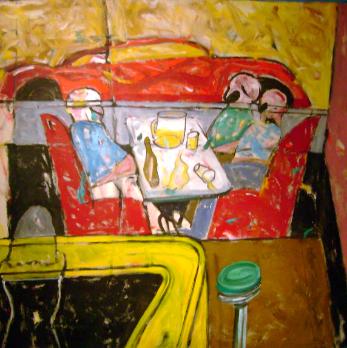
with wiry lines and obsessively repeated themes. One of his “People at an Exhibition” (2006-7)
paintings at CSU is part of a series dealing with what Nevadomi wryly calls “bar culture.” A starkly
sensual palette of red, black, white, and deep yellow tones shows a bar/café scene, splashed here
and there with white paint. This is similar to a technique pioneered by School of London artist
Francis Bacon (a notorious gambler), who actually threw paint at his canvases in a final gesture,
courting and daring chance to make or break his compositions. In “People at an Exhibition” the
intent seems a bit more calculated, bettering the odds that the painting’s intensity will sustain visual
interest. Nevadomi’s sideways spatters distract the eye, or gives it a jumping-off point, acting as an
extra layer; it’s as if we see the blurry scene through a pane of dirty glass. Three faceless, potato-
headed male figures eat and drink, accompanied by three women, also without features. One of
the women is passed out, nude, on the floor, at the left-hand margin of the painting. The direction
of her fallen body echoes and balances the black horse-shoe curve of the bar. At the upper right
one of the men has also passed out. His head rests on a table surface, pointing out of the picture
and continuing the composition’s circular motion. It’s not a happy scene, but it captures the fly-
specked, queasy-fuzzy disorientation of drunk nightlife to perfection. Shapes and colors move back
and forth, up and down, round and round, like a ride at an amusement park, hilarious, nauseating,
and hypnotic.
Random markings or brushstrokes, spread around the picture plane, are a common feature of
most of the paintings at “On the Corner Off.” In the Descartes diptych “I Think Therefore I Am, I
Think (2000-2003),” these are large and numerous enough to make an extra painting,
superimposed on the Descartes imagery. In this case, Nevadomi’s “two for the price of one”
devices resonate with the philosopher’s mind-body dualism, and, as elsewhere in the exhibition,
call to mind the multiple focal points and narrative P.O.V’s typical of modernist and postmodern
aesthetic structures.
“Frick/Frack (2000)” and “Airless (2000)” are organized in a similar way, clustering marks and
loose depictions around a central pictorial area (the bar, the Descartes portraits). But instead of
being painted directly on a single surface, they’re assembled, “woven” as Nevadomi puts it, from
small cut-up patches of previous canvases, arranged as if in a grid or like tiles in a mosaic. In
“Frick/Frack” these pieces are mostly covered with short, angular black marks, reminiscent of
classic cubist collage works -- except that here no specific object or scene is deconstructed;
instead, aspects of the painter’s habitual manner are the building blocks of a new abstract order.
These seem almost to shimmer and move in relation to each other and to the whole. Again the total
motion of the compositions is both circular and back and forth, as the eye shunts from the broad
surface to interior activity concentrated in the center of the work.
Throughout his various manners, Nevadomi remains concerned with visual conflict and ways of
resolving it. He unpacks the energy of marks, images, line and color as if emptying a bag of toy
soldiers, and deploys them around the battlefields – or playgrounds -- that are his surfaces.
Nevadomi’s disenchanted scenes can seem world-weary and grown-up enough to read as cynical,
yet there is an ongoing innocence inherent in his energetic style, and a winsome (if twisted)
suggestiveness to titles like “Caravaggio Light,” which shows a stripper seated at a bar, near a
large window that bathes her naked back in golden afternoon sunshine. Even at their most
dramatic Nevadomi’s paintings aren’t exactly “Caravaggio Lite” (though contemporary strip clubs
certainly might be), but they spread the fresh colors, quick wounds and dark thoughts of a younger
world on the canvas, at once playful and serious in their games.
Ken Nevadomi at CSU Gallery
by Douglas Max Utter
For more than thirty years Cleveland based painter Ken Nevadomi’s very personal iconography
and style have emerged from a mix of painterly concerns and an interest in ideas – often
underwritten by a tough vision of urban life. Sometimes, as in the 1986 “The Man Who Lived in a
Refrigerator” (which was one of two works by Nevadomi awarded the coveted Painting Prize in the
Cleveland Museum of Art’s 1986 May Show), these appear to comment on social conditions. But
Nevadomi is an activist only in the sense that he’s involved in the world at street level, with a keen
eye for anecdote and for the absurd. His often dream-like works argue for the importance of
beauty, stranded and disfigured as it may be amid the intensely emotional hues and harsh textures
of daily existence.
The one person show “On the Corner Off” consists mostly of large acrylic paintings, completed
over the past twelve years or so, which manage to hold their own in Cleveland State University’s
soaring gallery space. All are executed on unstretched canvas and pinned to the wall, stressing the
rough-edged immediacy of Nevadomi’s several recent manners. In these works passages of art
historical reference alternate with semi-comic, off-the-cuff observations, stirred briskly with bravura
brushwork and energetic spattering. Some depict interior scenes, others are nearly abstract, like
several six by ten foot diptychs on display, composed of two side-by-side sections that repeat key
motifs. Each of these features a graffiti-like tangle of boldly drawn images: things having to do with
the philosopher Renee Descartes, a selection of images derived from paintings by Matisse, and a
snarl of WWII-era bombers.
Nevadomi renders firmly outlined, cartoon-like human figures when he’s using paint on canvas,
although over the years one of the hallmarks of his works on paper has been a much more realistic
linear sensitivity. In the paintings at CSU Nevadomi’s underlying gifts as a draftsman and observer
become a matter of psychological overload; he achieves a shaky sense of pictorial balance by
tipping and turning shapes and sections of color in precarious combinations, winding them together
with wiry lines and obsessively repeated themes. One of his “People at an Exhibition” (2006-7)
paintings at CSU is part of a series dealing with what Nevadomi wryly calls “bar culture.” A starkly
sensual palette of red, black, white, and deep yellow tones shows a bar/café scene, splashed here
and there with white paint. This is similar to a technique pioneered by School of London artist
Francis Bacon (a notorious gambler), who actually threw paint at his canvases in a final gesture,
courting and daring chance to make or break his compositions. In “People at an Exhibition” the
intent seems a bit more calculated, bettering the odds that the painting’s intensity will sustain visual
interest. Nevadomi’s sideways spatters distract the eye, or gives it a jumping-off point, acting as an
extra layer; it’s as if we see the blurry scene through a pane of dirty glass. Three faceless, potato-
headed male figures eat and drink, accompanied by three women, also without features. One of
the women is passed out, nude, on the floor, at the left-hand margin of the painting. The direction
of her fallen body echoes and balances the black horse-shoe curve of the bar. At the upper right
one of the men has also passed out. His head rests on a table surface, pointing out of the picture
and continuing the composition’s circular motion. It’s not a happy scene, but it captures the fly-
specked, queasy-fuzzy disorientation of drunk nightlife to perfection. Shapes and colors move back
and forth, up and down, round and round, like a ride at an amusement park, hilarious, nauseating,
and hypnotic.
Random markings or brushstrokes, spread around the picture plane, are a common feature of
most of the paintings at “On the Corner Off.” In the Descartes diptych “I Think Therefore I Am, I
Think (2000-2003),” these are large and numerous enough to make an extra painting,
superimposed on the Descartes imagery. In this case, Nevadomi’s “two for the price of one”
devices resonate with the philosopher’s mind-body dualism, and, as elsewhere in the exhibition,
call to mind the multiple focal points and narrative P.O.V’s typical of modernist and postmodern
aesthetic structures.
“Frick/Frack (2000)” and “Airless (2000)” are organized in a similar way, clustering marks and
loose depictions around a central pictorial area (the bar, the Descartes portraits). But instead of
being painted directly on a single surface, they’re assembled, “woven” as Nevadomi puts it, from
small cut-up patches of previous canvases, arranged as if in a grid or like tiles in a mosaic. In
“Frick/Frack” these pieces are mostly covered with short, angular black marks, reminiscent of
classic cubist collage works -- except that here no specific object or scene is deconstructed;
instead, aspects of the painter’s habitual manner are the building blocks of a new abstract order.
These seem almost to shimmer and move in relation to each other and to the whole. Again the total
motion of the compositions is both circular and back and forth, as the eye shunts from the broad
surface to interior activity concentrated in the center of the work.
Throughout his various manners, Nevadomi remains concerned with visual conflict and ways of
resolving it. He unpacks the energy of marks, images, line and color as if emptying a bag of toy
soldiers, and deploys them around the battlefields – or playgrounds -- that are his surfaces.
Nevadomi’s disenchanted scenes can seem world-weary and grown-up enough to read as cynical,
yet there is an ongoing innocence inherent in his energetic style, and a winsome (if twisted)
suggestiveness to titles like “Caravaggio Light,” which shows a stripper seated at a bar, near a
large window that bathes her naked back in golden afternoon sunshine. Even at their most
dramatic Nevadomi’s paintings aren’t exactly “Caravaggio Lite” (though contemporary strip clubs
certainly might be), but they spread the fresh colors, quick wounds and dark thoughts of a younger
world on the canvas, at once playful and serious in their games.